
Choosing the Right Solution with VAHLE Power Transmission Systems
On moving cranes, transfer carts, conveyor lines, port equipment and automation systems, “uninterrupted power transfer” is often the hidden determinant of production continuity. Because every moving system shares a common problem: carrying power and control/data lines safely. If a cable drags on the ground it gets crushed, tangled and torn; if power is cut the line stops; if the control signal is disrupted the equipment goes into safe mode. That is why choosing the right power transmission solution is not merely an electrical decision — it is directly a decision about efficiency, maintenance cost and occupational safety.
In this article we will compare the power-supply methods most commonly used on moving equipment, then explain in which scenarios VAHLE conductor rail and VAHLE festoon (cable trolley) systems deliver the best results. We will also illustrate how VAHLE systems form an integrated solution architecture together with BM Makina’s KATO cable reels, BKB / ALUBKB light crane systems and LIFTKET lifting solutions.
Power-supply options for moving equipment
In practice there are three main approaches to carrying power and signal/data on moving systems:
1) Cable Reel (motorized / spring)
- Very common in long-stroke and mobile applications.
- The power cable is paid out/reeled in a controlled way from the drum.
- A strong solution especially for outdoor sites and heavy-duty machines (mobile cranes, electric construction machinery, etc.).
BM Makina’s KATO motor-driven cable reels are a solution family aiming for controlled reeling and high durability in long-distance, heavy-cable applications.
2) Conductor Rail
- Stands out on bridge cranes, monorail lines, transfer carts and fixed-route moving systems.
- Power is transferred over a fixed line; the moving equipment picks it up with a collector.
- A tidy, clean, low-maintenance and “systematic” solution.
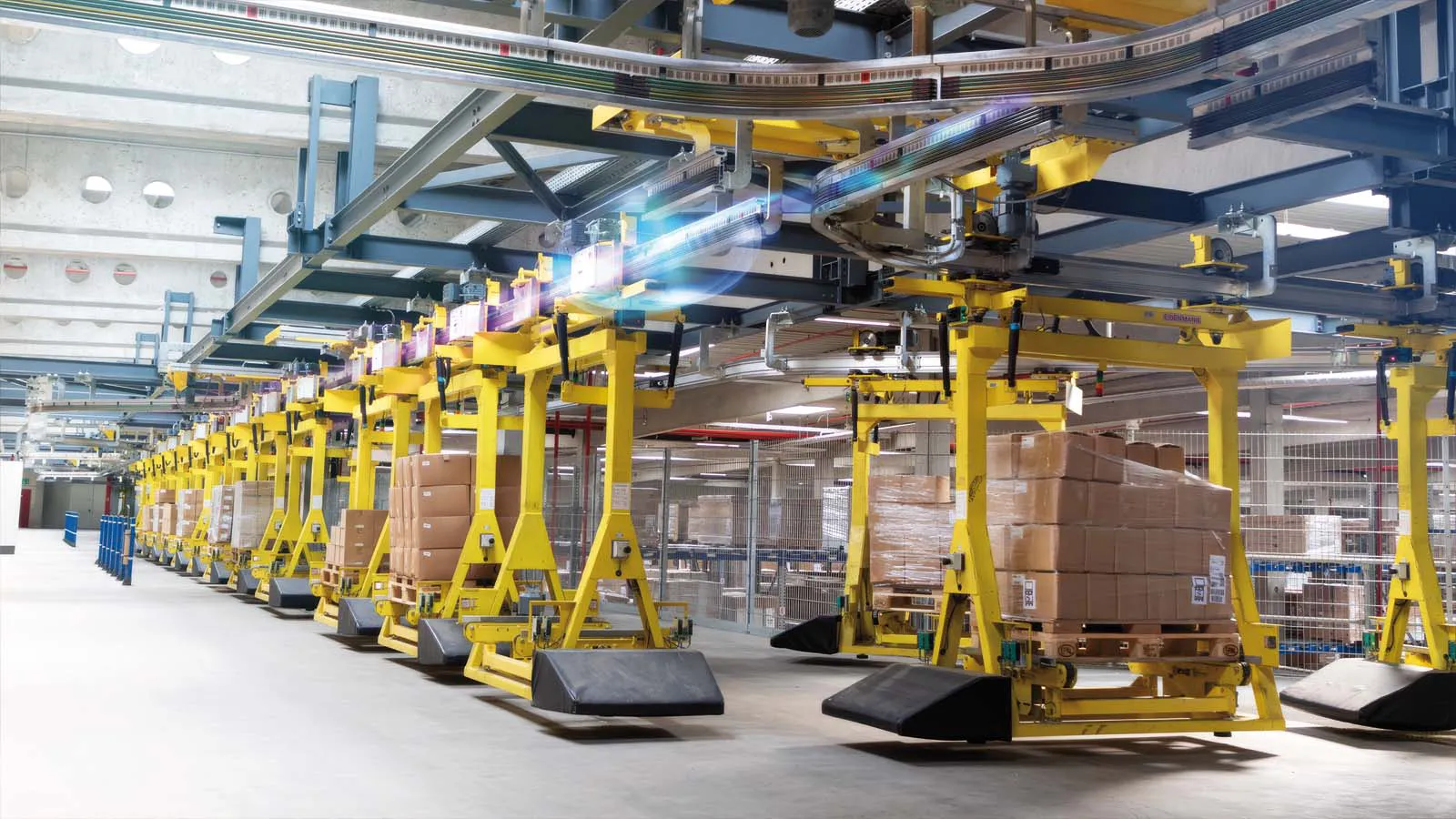
3) Cable Trolley / Festoon System (C-rail + carrier trolleys)
- Ideal for bridge cranes, crane movements and places where a cable package must be carried.
- The cable is carried tidily, moving on carrier trolleys.
- Delivers very practical results especially when power + control cables must be carried together.
Why are VAHLE solutions preferred?
VAHLE Conductor Rail Systems
VAHLE conductor rail systems are designed to transfer power to moving equipment safely and sustainably over a fixed line. When engineered correctly, they:
- Provide uninterrupted power transfer (stable supply throughout the movement)
- Offer less cable wear and lower fault risk
- Create a tidier plant appearance (less cable clutter)
- Make maintenance processes predictable (periodic inspection, collector maintenance, etc.)
- Lower the total cost on long lines and high duty cycles
Especially on fixed-route cranes and in-line transfer systems, conductor rail offers a cleaner architecture with the logic of “carrying the power along the line” instead of “carrying the cable”.
VAHLE Festoon (Cable Trolley) Systems
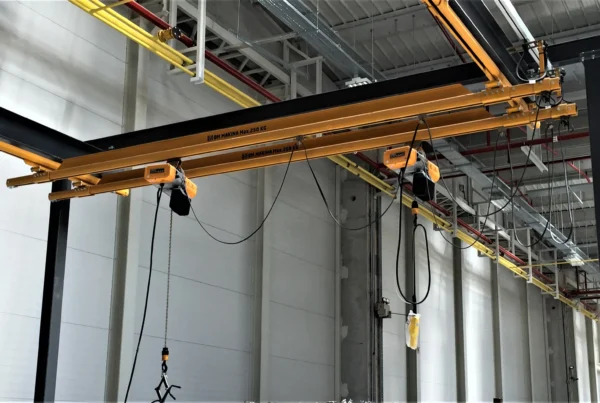
Festoon systems carry power and control cables tidily with carrier trolleys moving on a C-rail. Their advantages:
- Prevent the cable from sagging and dragging on the floor
- Standardize cable management on bridge cranes and moving machines
- Are modular for assembly/service
- Provide continuity of control signals since power + control cables can be carried together
Which should be chosen and when?
The main criteria that determine the right choice are:
1) Stroke (travel distance)
- Short/medium stroke + tidy line: VAHLE conductor rail or festoon systems
- Very long stroke / mobile equipment: reel solutions such as the KATO motorized cable reel
2) Speed and duty cycle
- High cycle / intensive operation: conductor rail systems are more efficient in the long run
- Variable speed / heavy cable: the reel system offers the advantage of controlled reeling
3) Environmental conditions
- Factors such as dust, moisture, chemical exposure, outdoors and corrosion determine the protection class and material selection.
- In environments such as ports, mines and foundries, the right protection and the right mechanical design are critical.
4) Power + data needs
- If not only power but also control, sensor and automation signals will be carried, the system architecture must be set up correctly.
- In some projects the power transmission system and data transmission are handled together (cable selection, shielding, earthing, route plan).
The integrated-solution approach with BM Makina
BM Makina produces solutions in the field not through a single product but through “complementary systems”. On the power transmission side, VAHLE systems create a stronger overall solution when engineered together with the following BM Makina products:
BKB & ALUBKB light crane systems + VAHLE
- VAHLE festoon solutions are an ideal match for carrying power and control cables on BKB/ALUBKB bridge systems.
- With tidier cable management, lower friction and higher occupational safety, the system becomes a “line standard”.
LIFTKET lifting systems + VAHLE
- On crane systems that include lifting equipment such as LIFTKET, the continuity of power transmission directly affects operational safety.
- With VAHLE power transmission, the lifting + travel + control components are engineered with the same approach.
KATO cable reels + VAHLE (hybrid approach)
In some projects a single solution is not enough:
- While power is carried on the main line with a VAHLE conductor rail, a KATO motorized reel can be brought in on certain movement axes.
- Thus both clean power transfer along the line and long-stroke management on special axes are solved within the same system.
This “integrated design” approach makes plant maintenance management easier, lowers fault risk and provides a scalable infrastructure as the project grows.
Points to watch in project design
After the power transmission systems are selected, the critical point that determines performance is the quality of engineering:
- Current/voltage values and voltage-drop calculation
- Suitable collector selection and contact pressure
- Cable route, sag allowance, mechanical protection
- Earthing, leakage current, short-circuit protection coordination
- Periodic maintenance plan (collector, line inspection, connection-tightness checks)
With its field experience, BM Makina optimizes the solution by evaluating these parameters not just from a catalogue but under real operating conditions.
Conclusion
On moving systems, power transmission is far too critical to be left at the “it works” level. With the right solution choice and the right integration, stoppages decrease, maintenance costs fall, occupational safety increases and the system’s life is extended. VAHLE conductor rail and VAHLE festoon (cable trolley) solutions provide a clean, sustainable power-transfer infrastructure compliant with industrial standards in many scenarios, from bridge cranes to transfer lines. And when handled together with BM Makina’s BKB/ALUBKB, LIFTKET and KATO product families, the result is a strong end-to-end engineering solution.